
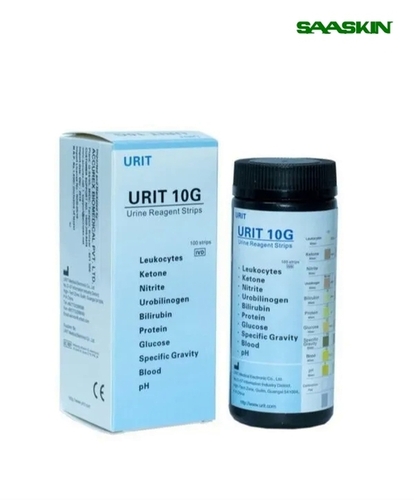
| Parameter Urinalysis | 10 Parameter |
| Number of Strips | 100 Strips |
| Brand | Urit |
| Name Of Manufacturer | Unit Medical Electronic Co.LTD |
| Elevated Specific | 5g/L |
| Date Of Manufacturing | 20240413 |
| Shelf Life | 2 Years |
| Manufacturer By | Urit Medical Electronic Co.Ltd |
| Store Temperatures | 30 Degree C |
| Lot NO | 24031712M2 |
| Specific Gravity | 1.030 |
| Ascorbic Acid Concentrations | 1,4mmol/l |
Urit 10g urine reagent strips consist of a plastic strip affixed with reagent papers and a calibration pad. This feature facilitates measurement of multiple urine constituents and use for everyday diagnosis and group examinations. The calibration pad, which is not impregnated with reagents, allows instrumental correction interference from natural color of urine automatically and obtains accurate result.
Urit 10g urine reagent strips provide tests for the semi-quantitative measurement of leukocytes, ketone, nitrite, urobilinogen, bilirubin, protein, glucose, specific gravity, blood and ph in urine. For use with the urine analyzers of uritest-50/500/500b,urit-30/50/180/330/500b/500c. The test is intended for use by health care professionals.
About:Urit 10g urine reagent strips consist of a plastic strip affixed with reagent papers and a calibration pad. This feature facilitates measurement of multiple urine constituents and use for everyday diagnosis and group examinations. The calibration pad, which is nleukocytes: the test reveals the presence of granulocyte esterases. These esterase’s cleave an indoxyl ester, and the indoxyl so liberated reacts with a diazonium salt to produce a violet dye.Leukocyte estefpe results may be positive in the absence of observable cells if the leukocytes have lysed. Nitrite: the test is based on the principle of griess’s test and is specific to nitrite. Any degree of uniform pink colour development should be interpreted as a positive. Nitrite test suggesting the presence of 10′ or more organisms per ml, but colour development is not proportional to the number of bacteria present. A negative result does not in itself prove that there is no significant bacteriuria. Negative results may occur when urinary tract infections are cause by organisms which do not contain reductase to convert nitrate to nitrite, when urine has not been retained in the bladder long enough (4-&hrs) for reduction of nitrate to occur, or when dietary nitrate is absent, even if organisms containing reductase are present and bladder incubation is ample. Ascorbic acid concentrations of 1.4mmoIL. Or greater may cause false negative results with specimens containing nitrite ion concentrations of 58umol/l, or less