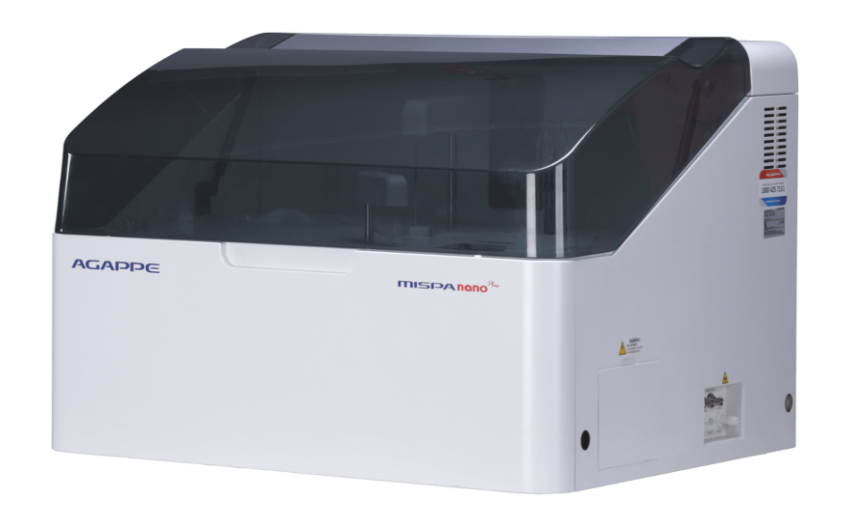
| Analyzer Type |
Fully Automated, Discrete, Random Access Clinical Chemistry Analyzer |
| Throughput |
Up to 360 photometric tests/hour |
| Measuring Principle |
Absorbance photometry and turbidimetry |
| Photometric System |
Grating photometry system |
| Methodology |
End-point, Fixed-time, Kinetic, Single & Dual reagent, Mono/Bichromatic |
| Wavelength Range |
12 wavelengths: 340, 380, 412, 450, 505, 546, 570, 605, 660, 700, 740, 800 nm |
| Absorbance Range |
0 – 3.5 Abs (resolution 0.0001 Abs) |
| Sample Volume |
2 – 35 µL |
| Reagent Volume |
R1: 100–200 µL, R2: 10–200 µL |
| Reaction Volume |
100 – 360 µL |
| Sample Positions |
50 positions |
| Reagent Positions |
50 positions (refrigerated 2–12 °C) |
| Reaction Cuvettes |
80 reusable cuvettes |
| Reaction Temperature |
37 °C ± 0.1 °C |
| Mixing System |
Independent mixing bar |
| Probe Features |
Liquid level detection, vertical collision protection, optional clot detection |
| Dilution Facility |
Automatic pre-dilution and post-dilution |
| Carryover |
< 0.05% |
| Calibration Methods |
Linear, multipoint, spline, polynomial, exponential, logit-log |
| Quality Control |
Westgard rules, Levey-Jennings charts, cumulative sum check |
| Operating System |
Windows-based software with LIS connectivity |
| Power Supply |
200–240 V, 50/60 Hz |
| Power Consumption |
Approx. 1300 VA |
| Water Consumption |
Approx. 6.5 L/hour |
| Dimensions (L×D×H) |
860 × 660 × 550 mm |
| Weight |
Approx. 115 kg |